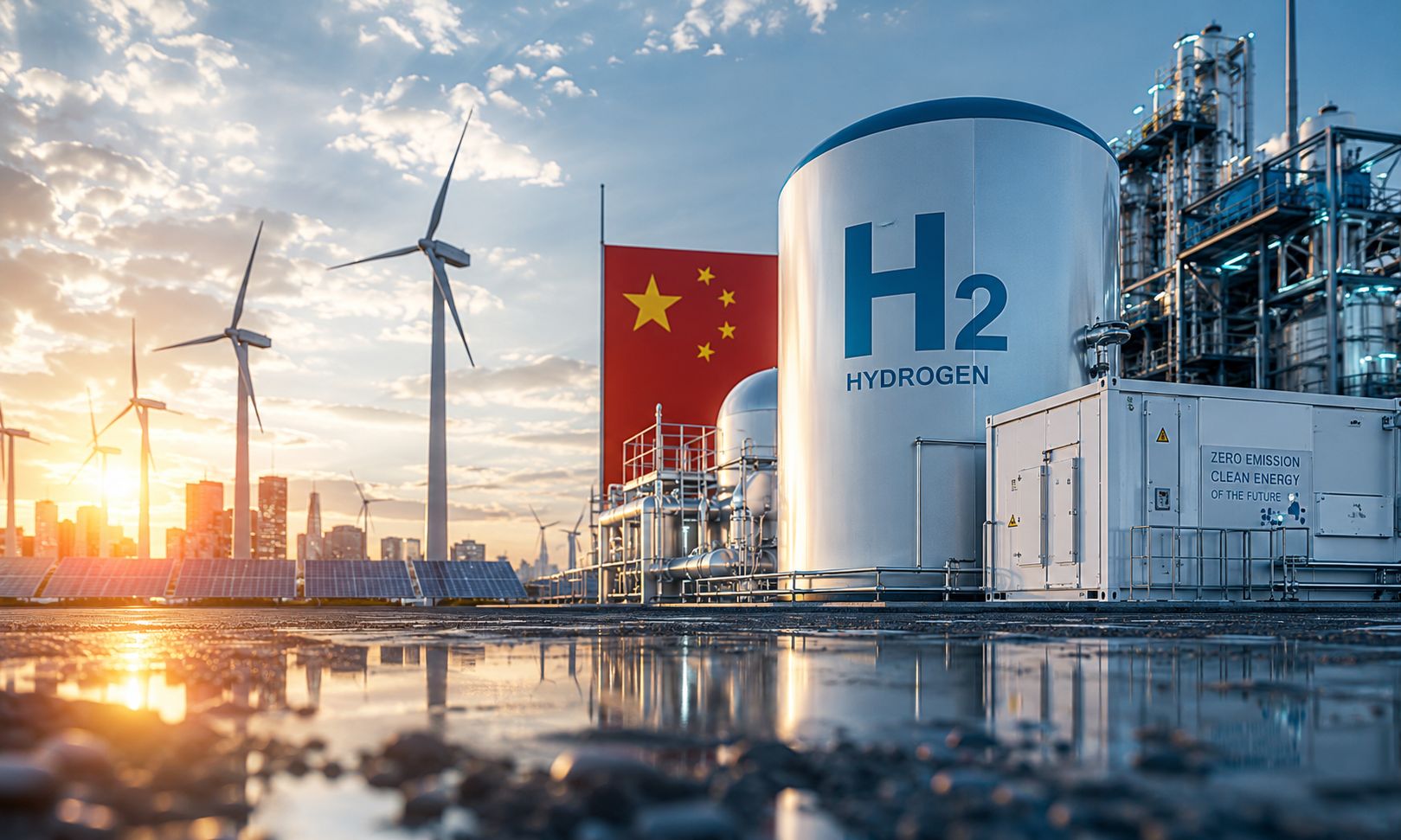
China’s newly approved 15th Five-Year Plan (2026–2030) may ultimately be remembered as the moment hydrogen moved from the margins of China’s energy policy into the center of its long-term industrial strategy. While previous plans emphasized hydrogen pilot projects, demonstration cities, and fuel-cell vehicle experimentation, the new plan treats hydrogen as something much larger: a foundational technology tied to energy security, industrial competitiveness, renewable energy integration, and geopolitical resilience.
For years, hydrogen outside China was often discussed primarily in the context of passenger vehicles. That narrative increasingly appears outdated. Beijing’s latest policy direction suggests China sees hydrogen less as a “car fuel” and more as a strategic industrial molecule capable of reshaping heavy industry, balancing electrical grids, absorbing excess renewable energy, and reducing dependence on imported fossil fuels.
The 15th Five-Year Plan does not always mention hydrogen in dramatic headline language, but the strategic implications become clear when the plan is read alongside ministry guidance, state media analysis, and industry commentary. Hydrogen is now woven into China’s broader push for what policymakers call “new quality productive forces” — advanced industries intended to define the country’s next phase of economic growth.[1]
Hydrogen’s New Role in China’s Energy System
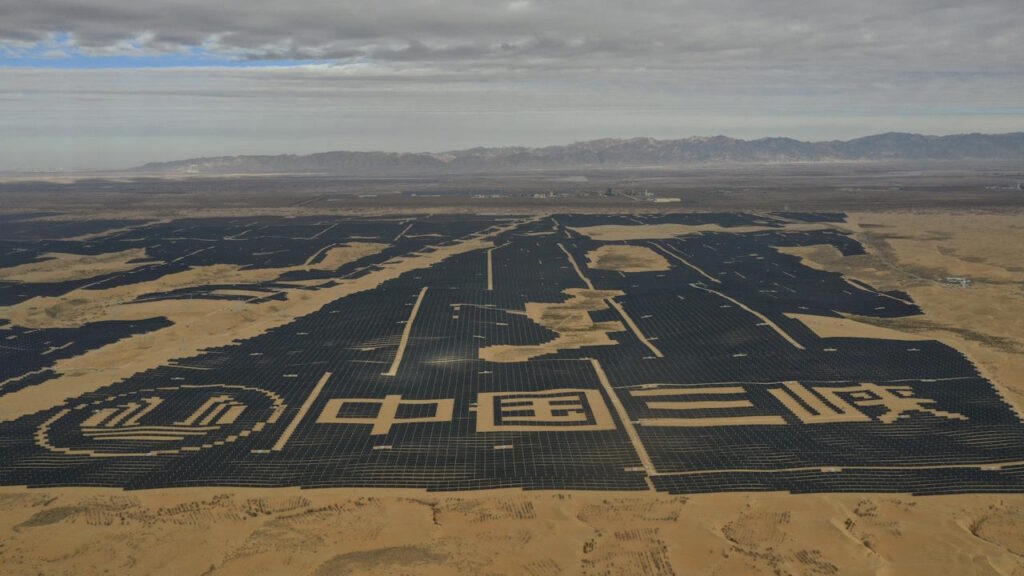
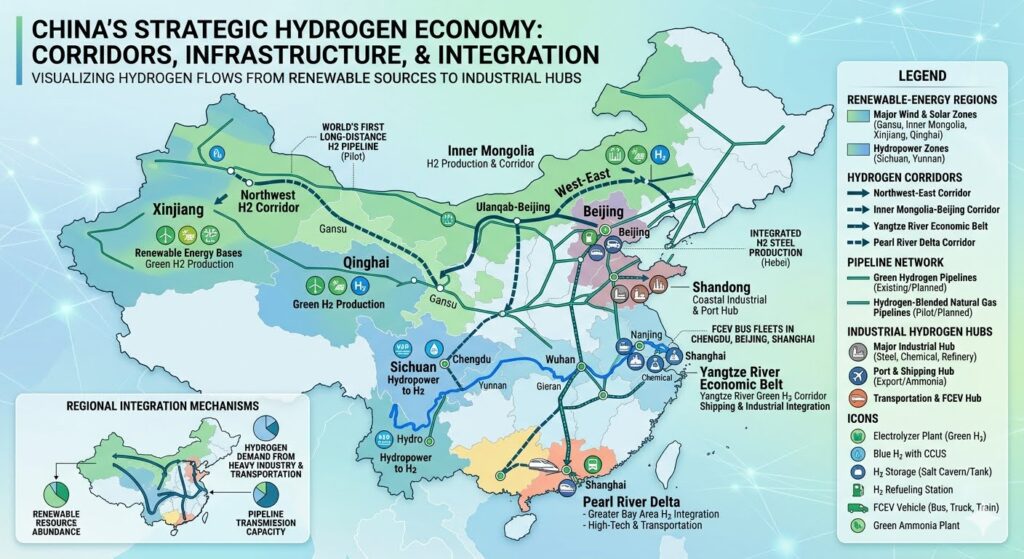
One of the most important developments in the new Five-Year Plan is the recognition that hydrogen can help solve a growing problem created by China’s rapid renewable-energy expansion. China has built enormous amounts of solar and wind capacity across remote western and northern regions including Inner Mongolia, Xinjiang, Gansu, and Qinghai. In many cases, renewable generation has expanded faster than transmission infrastructure or local demand, leading to periods where electricity is curtailed or underutilized.
Hydrogen offers a way to convert surplus renewable electricity into transportable energy. Instead of wasting excess power generation, China can use electrolysis to create hydrogen, which can then be stored, transported, converted into ammonia, or used directly in industrial applications.[2]
This is a significant shift in thinking. Hydrogen is increasingly viewed not as a competitor to batteries, but as a complementary technology for sectors where batteries are impractical. The Chinese government appears to be targeting hydrogen for long-duration energy storage, industrial feedstocks, heavy transportation, shipping, and high-temperature industrial processes.
This also aligns with China’s broader push to create what officials describe as a “new type of energy system,” one that combines renewable power, grid modernization, storage technologies, and flexible industrial energy use.[3]
Moving Beyond Demonstration Projects
During the 14th Five-Year Plan period (2021–2025), much of China’s hydrogen activity focused on proving the technology worked. Provincial governments launched fuel-cell truck pilots, demonstration cities were selected, and state-owned enterprises experimented with early hydrogen infrastructure.
The new 15th Five-Year Plan appears to represent the transition from experimentation to deployment.
Rather than focusing narrowly on hydrogen vehicles, the new policy direction emphasizes full supply-chain development. That includes electrolyzer manufacturing, hydrogen production hubs, industrial integration, transportation infrastructure, storage systems, and hydrogen-derived fuels such as ammonia and methanol.[4]
China is no longer simply trying to “have a hydrogen industry.” It is attempting to dominate the entire ecosystem around hydrogen production and utilization.
There are strong parallels to China’s earlier solar and battery strategies. In those sectors, China combined industrial policy, state financing, export incentives, and manufacturing scale to become the dominant global supplier. The hydrogen strategy increasingly appears to follow the same template.
Hydrogen and Industrial Decarbonization
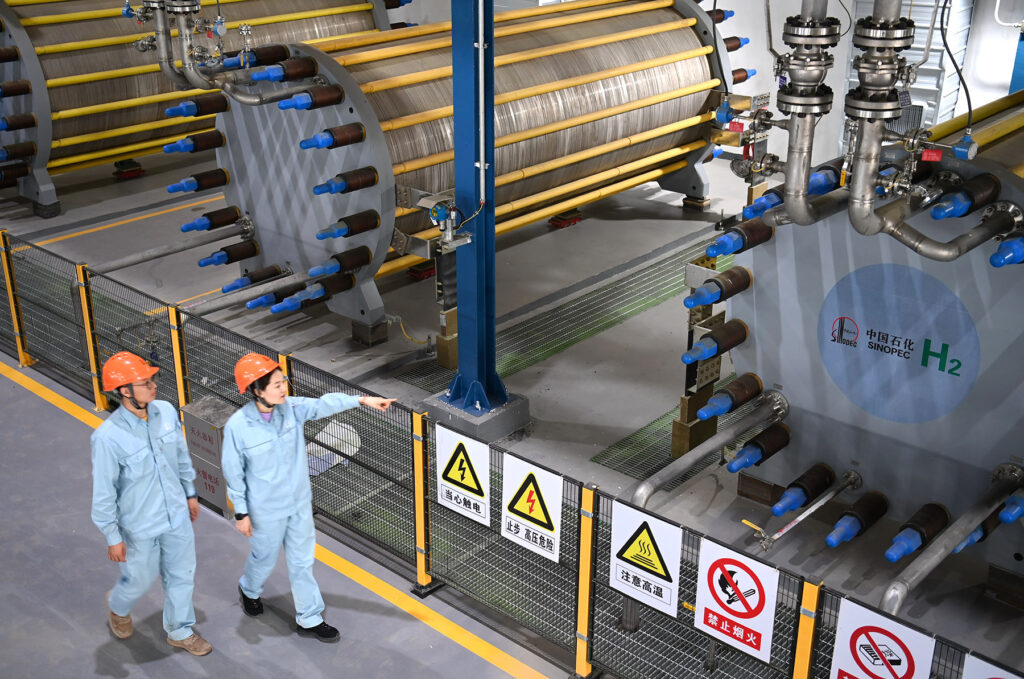
One of the clearest themes emerging from the new plan is hydrogen’s role in decarbonizing heavy industry. China remains the world’s largest producer of steel, cement, chemicals, and industrial materials, sectors that are difficult to electrify directly.
Hydrogen is increasingly viewed as one of the few viable pathways for reducing emissions in these industries without sacrificing production capacity.
Steelmaking is particularly important. Traditional blast furnace steel production relies heavily on coking coal. Hydrogen-based direct reduced iron (DRI) technologies offer a potential alternative that could significantly lower emissions if sufficient low-carbon hydrogen becomes available.[5]
Similarly, hydrogen is becoming increasingly important for:
- ammonia and fertilizer production,
- petroleum refining,
- methanol production,
- shipping fuels,
- synthetic aviation fuels,
- and high-temperature industrial heat.
This reflects a more mature understanding of where hydrogen is economically useful. China’s policymakers increasingly appear focused on sectors where electrification alone may not be sufficient.
In practical terms, this means the future of China’s hydrogen industry may depend less on passenger cars and more on steel mills, chemical plants, ports, freight corridors, and export-oriented manufacturing zones.
Energy Security and Strategic Independence
Another major driver behind China’s hydrogen push is energy security.
China remains heavily dependent on imported oil and natural gas. Maritime shipping routes, especially through the Strait of Malacca, remain a long-standing strategic vulnerability for Beijing. The government has repeatedly emphasized reducing exposure to external energy disruptions.
Hydrogen fits naturally into this strategy because it can be produced domestically using a wide range of energy inputs:
- solar,
- wind,
- hydroelectric,
- nuclear,
- biomass,
- and even coal with carbon capture technologies.
In other words, hydrogen offers flexibility. It allows China to transform domestic energy resources into storable industrial fuel and feedstocks rather than relying exclusively on imported hydrocarbons.[6]
The emphasis on “energy security” appears repeatedly throughout commentary surrounding the 15th Five-Year Plan. Increasingly, Chinese policymakers do not separate climate policy from national security policy. Renewable energy, battery storage, grid modernization, and hydrogen are all being treated as components of a broader resilience strategy.
This helps explain why hydrogen continues receiving political support even when many projects remain economically challenging in the short term. From Beijing’s perspective, the long-term strategic value may outweigh near-term profitability concerns.
China’s Manufacturing Ambitions
China already holds a strong position in global electrolyzer manufacturing. Chinese firms have dramatically reduced equipment costs in recent years, creating growing pressure on Western and Japanese competitors.
The 15th Five-Year Plan strongly suggests Beijing wants to extend this advantage across the broader hydrogen supply chain.[7]
That could include:
- electrolyzers,
- hydrogen storage systems,
- fuel cells,
- industrial compressors,
- hydrogen transport equipment,
- ammonia production systems,
- and hydrogen-powered heavy vehicles.
If China succeeds, it could reshape global hydrogen economics much the way Chinese solar manufacturing transformed the photovoltaic market over the past two decades.
Lower equipment costs could accelerate worldwide hydrogen deployment. At the same time, they could create major competitive challenges for manufacturers in Europe, Japan, South Korea, and North America.
This industrial dimension is critical to understanding China’s hydrogen strategy. Beijing does not appear interested merely in becoming a hydrogen consumer. It wants to become the dominant supplier of hydrogen infrastructure technologies globally.
Infrastructure Expansion Ahead
Although the national plan itself does not provide detailed infrastructure quotas, most analysts expect substantial expansion of hydrogen infrastructure during the 2026–2030 period.
Likely priorities include:
- hydrogen pipelines,
- industrial hydrogen hubs,
- refueling corridors for heavy trucking,
- port infrastructure,
- ammonia terminals,
- underground storage,
- and integrated renewable-hydrogen industrial parks.[8]
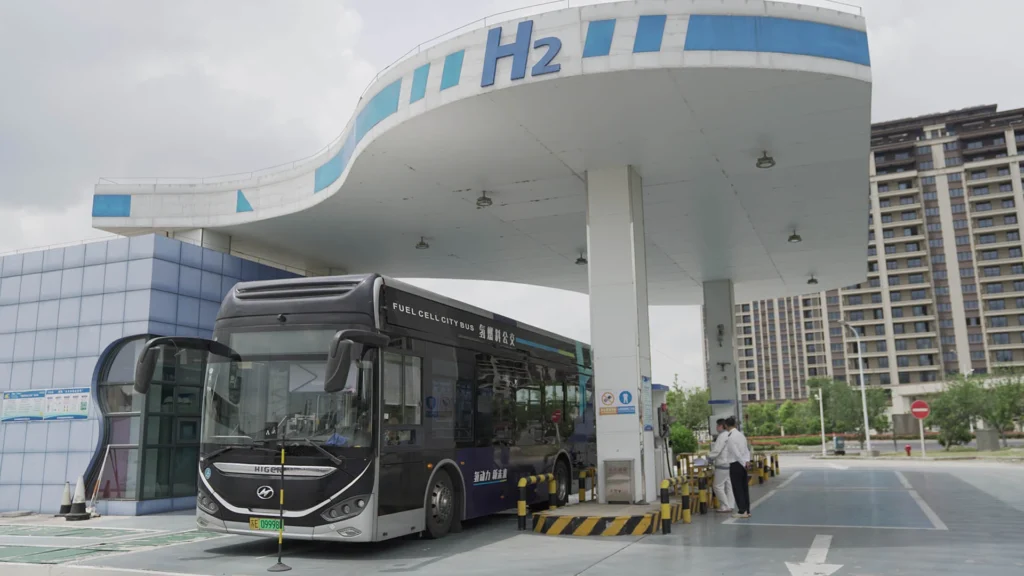
China already has one of the world’s largest hydrogen refueling station networks, though utilization rates vary widely. The next stage will likely focus less on symbolic infrastructure and more on creating economically integrated industrial ecosystems where hydrogen production and consumption occur at scale.
Large state-owned enterprises are expected to play a central role. Companies in the power, petrochemical, shipping, and industrial sectors are likely to become major hydrogen developers during the next five years.
The Bigger Picture
The most important takeaway from China’s 15th Five-Year Plan may be that hydrogen is no longer treated as a niche or experimental technology. It is becoming part of a coordinated national strategy that links industrial policy, energy security, renewable integration, manufacturing leadership, and geopolitical competitiveness.
Whether China ultimately succeeds in making hydrogen economically viable at massive scale remains uncertain. Many hydrogen projects globally continue to face challenges involving cost, efficiency, infrastructure, and demand creation.
But China has repeatedly demonstrated its willingness to invest heavily in strategic industries long before profitability is fully established. Solar panels, lithium-ion batteries, and electric vehicles all followed a similar trajectory.
The new Five-Year Plan suggests hydrogen may be next.
If that happens, the implications will extend far beyond China itself. Global supply chains, industrial energy systems, transportation fuels, and clean-energy competition could all be shaped by decisions now being made in Beijing.
For the rest of the world, the question may no longer be whether hydrogen will matter. The more important question is whether China will dominate the industries built around it.
Footnotes:
Footnote [1] – “15th Five-Year Plan.” International Energy Agency (IEA), https://www.iea.org/policies/31351-15th-five-year-plan.
Footnote [2] – “China to Build a New Type of Energy System.” China.org.cn, https://www.china.org.cn/2026-04/23/content_118459018.shtml.
Footnote [3] – “Clean-Energy Expansion During 2026–2030.” China.org.cn, https://www.china.org.cn/2026-03/09/content_118372245.shtml.
Footnote [4] – “China’s New 5-Year Plan Bets on Tech Innovation Built on Energy Transition Security.” ICIS, https://www.icis.com/explore/resources/news/2026/03/13/11188488/insight-china-s-new-5-year-plan-bets-on-tech-innovation-built-on-energy-transition-security/.
Footnote [5] – “What’s in China’s New Five-Year Plan for Commodity Markets?” Reuters, https://www.reuters.com/sustainability/climate-energy/whats-chinas-new-five-year-plan-commodity-markets-2026-03-05/.
Footnote [6] – “China’s Nuclear Energy Priorities Under its 15th Five-Year Plan.” Center for Strategic and International Studies (CSIS), https://www.csis.org/analysis/chinas-nuclear-energy-priorities-under-its-15th-five-year-plan.
Footnote [7] – “China Excludes EVs from Latest Five-Year Plan as Industry Grapples with Oversupply.” Reuters, https://www.reuters.com/business/autos-transportation/china-excludes-evs-latest-five-year-plan-industry-grapples-with-oversupply-2025-10-28/.
Footnote [8] – “China’s Clean Energy Transition and the 15th Five-Year Plan.” China Briefing, https://www.china-briefing.com/news/chinas-clean-energy-transition-15th-five-year-plan/.
Leave a Reply