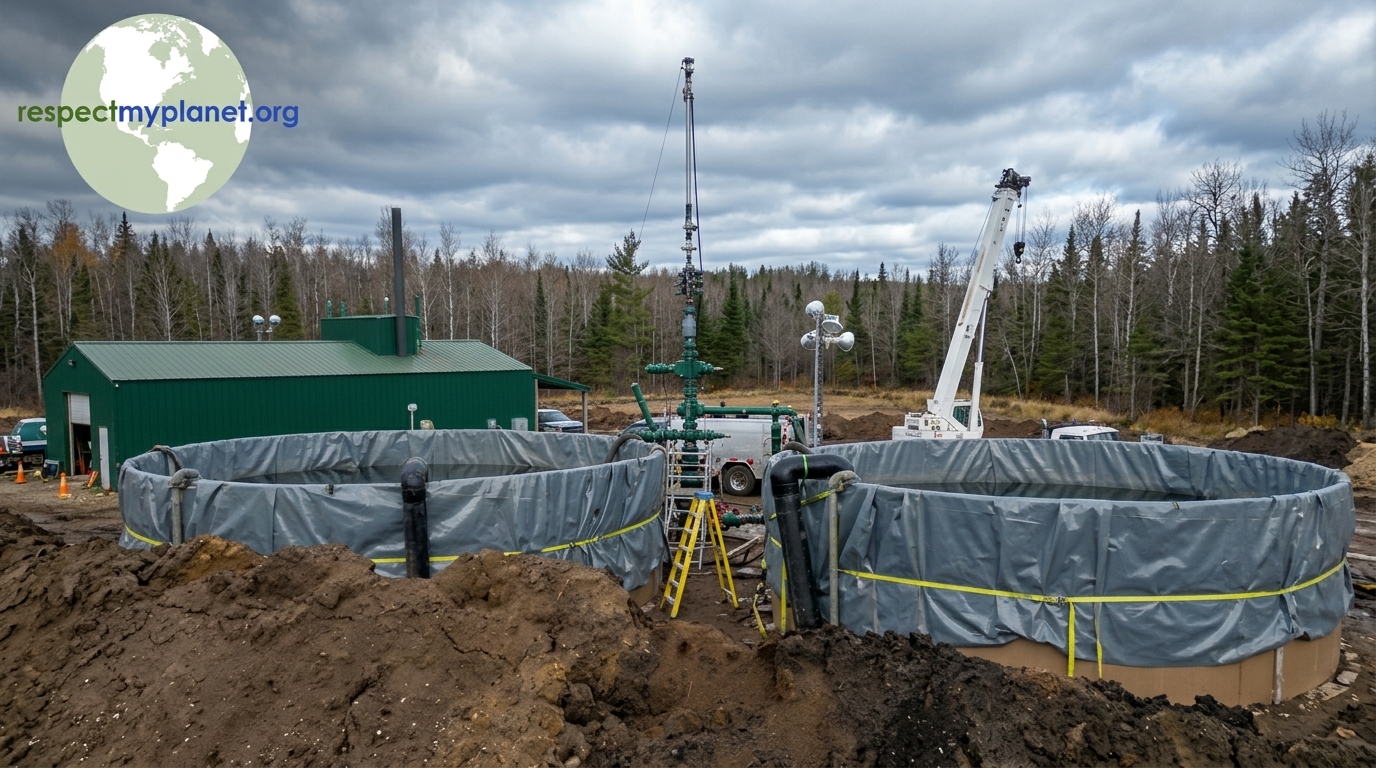
KALKASKA CO., MI — The Patterson-UTI APEX-PK drilling rig is gone, the vertical and 7,300-foot horizontal wellbore is in the ground, and FortyFive Energy LLC has officially moved into the completion staging phase at the State Excelsior 1-14 HD1 well site.
Fresh field photography and video captured on-site show two major developments: the massive above-ground water containment systems are actively being filled, and a high-pressure completion wellhead—commonly called a “frac tree” or “Christmas tree”—has been bolted onto the wellhead.
For those following our coverage since November 2025, this is the exact timeline we projected. After spudding in late September 2026, FortyFive Energy is gearing up to stimulate Michigan’s deep Utica-Collingwood formation for the first time in over 13 years.
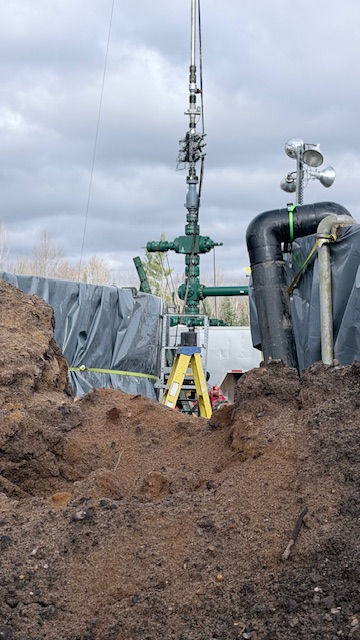
Locked and loaded for stimulation: With the Patterson drilling rig gone, a high-pressure frac stack and overhead wireline assembly now tower above the Excelsior B1-24 pad as above-ground containment walls prepare to hold 17.4 million gallons of frack water. (Photo credit: Neo)What We Are Seeing on the Ground
In the latest photos from the field, the site looks like a massive water-management operation rather than a traditional drilling site: [1]
- The “Frac Tree” is On: Rather than a standard, low-profile production Christmas tree used once a well is flowing, the assembly currently sitting over the hole is a heavy-duty, high-pressure frac stack. Those oversized master valves, wing valves, and high-pressure iron connections are built to isolate and control the extreme downhole pressures required to pump millions of gallons of fluid nearly 9,000 feet down and over 7,300 feet sideways into the tight carbonate rock.
- Above-Ground Water Impoundments Filling Up: True to the permit conditions prohibiting traditional earthen reserve pits, FortyFive Energy has erected massive, modular, lined above-ground containment tanks. As seen in the photos, water is actively being pumped in to stage the estimated 17.4 million gallons (17,394,300 gallons) approved under the state’s Water Withdrawal Assessment Tool (WWAT).
- The Oliver-to-Excelsior Pipeline in Action: As we reported back in November 2025, the Excelsior B1-24 pad only has two water supply wells (500 gpm combined). The bulk of this water is being drawn from four 200-foot glacial drift wells on the Oliver A3-1 Facility Pad 2.75 miles to the south (1,200 gpm combined), stored, and pumped north through the pigged Sunset Trail Pipeline. Seeing these containment structures filling confirms that cross-pad water transfer is underway.
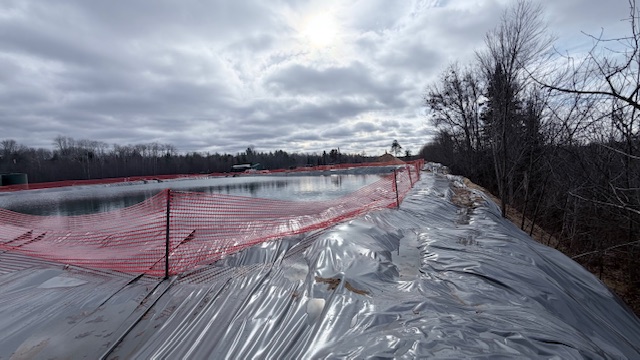
The 17.4-million-gallon reservoir: Looking out across the massive, geomembrane-lined in-ground water impoundment pit on the Oliver A3-1 Facility Pad, located 2.75 miles south of the State Excelsior 1-14 HD1 wellhead. Four 200-foot glacial drift supply wells on this pad are permitted to pump up to 1,200 gallons per minute to fill this basin before transferring the water north via the Sunset Trail Pipeline. (Photo credit: Neo)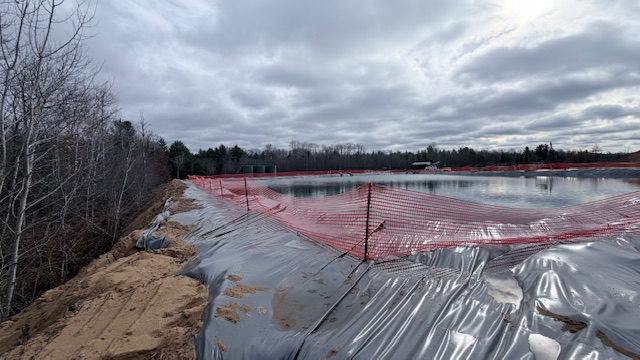
Another angle of the massive Oliver A3-1 impoundment: Looking across the synthetic-lined earthen pit to a different angle, showing the sheer footprint required to stage up to 17.4 million gallons of fresh groundwater before pumping begins. (Photo credit: Neo)Why Doesn’t This Look Like 2013?
Anyone who remembers the Encana and Halliburton mega-fracks across Kalkaska County from 2010 to 2013 might look at these pictures and wonder: Where is all the iron?
Back in 2013, a Collingwood completion site looked like an industrial army base. There were dozens of monstrous, roaring diesel pumper trucks, rows of pallet-sized chemical totes (“cubes”), and endless lines of pneumatic sand trucks feeding massive blenders. Right now, none of that is on pad.
There are two reasons why this site looks completely unfamiliar—one logistical, and one potentially geological:
1. We Are Looking at the Staging Phase, Not the Pumping Phase
Filling 17.4 million gallons of water storage at 1,200 to 1,700 gallons per minute takes roughly a week to ten days of continuous pumping. Operators do not pay $100,000+ a day for a full hydraulic fracturing spread to sit idle while water tanks fill. Today, a specialized wireline and wellhead crew installs the frac stack and pressure-tests the casing while water transfer crews fill the pits. Once the water volume is on-site, the pressure-pumping fleet rolls in.
2. The “Sandless” Acid-Frack Variable
Even when the pumping trucks arrive, this job may still look very different from the Halliburton completions of 2013. As RMP uncovered in FortyFive Energy’s EQP-7200-26 chemical pre-disclosure filing, zero sand or proppant was listed. While operators are not legally required to pre-disclose sand on that specific form, the chemical list was heavily loaded with HCR-7000 synthetic retarded acid, standard HCl, nine friction reducers, and four biocides.
If CEO Eric Collette—who previously worked at Marathon Oil when it acquired Encana’s Michigan Collingwood acreage—is testing a pure acid-fracturing strategy, you will never see the endless parade of sand trucks and mountain-sized sand storage bins (“sand castles”) that defined the 2013 era. Instead of using tens of millions of pounds of sand to mechanically prop fractures open, retarded acid is pumped deep into the 150°F carbonate marl to chemically etch permanent flow channels (“wormholes”) into the rock.
Watch the Excelsior pad staging setup (7-second pan): Scanning across the modular, above-ground water tanks flanking the State Excelsior 1-14 HD1 wellhead—look closely right in the center between the walls to spot the green high-pressure frac tree bolted over the hole. Because earthen pits are prohibited at this well site, water from the massive impoundment on the Oliver A3-1 south pad is pumped 2.75 miles north through the pigged Sunset Trail Pipeline into these holding tanks on the Excelsior pad with the high volume hydraulic fracturing will take place. (Video credit: Neo)What Happens Next?
At this stage, we have to be honest about what we know and what remains behind the curtain. Because Michigan EGLE granted the State Excelsior 1-14 HD1 tight-hole status, the exact completion procedure—whether FortyFive Energy is running a 100% sandless acid-etch job or quietly bringing in proppant at the eleventh hour—is confidential for now.
What we do know is that you don’t bolt on a high-pressure frac tree and pump millions of gallons of cold transitional stream water through a 2.75-mile pipeline unless you are days away from stimulating the wellbore.
RMP will keep eyes on the pad as the pumping spread moves in. Once stimulation wraps up and flowback begins, the real test starts. As we have said for over a decade: it’s all about the rock. Whether FortyFive Energy uses acid, sand, or a hybrid of both, only sustained Initial Production Results (IPR) will tell us if they finally cracked the code on Michigan’s stubborn Collingwood formation—or if history is about to repeat itself.
These images were shot on Monday, November 9, 2026, right as water staging hit full stride. As this post goes live on Saturday, November 14, completion operations at the State Excelsior 1-14 HD1 are almost certainly underway. Somewhere out in the northern Michigan pines right now, Neo is already back on two wheels, quietly documenting the next chapter of this well from the edge of the tree line in the Kalkaska state forest. Keep an eye on RMP—more dispatches from the field are coming soon.
Field Notes & Video Context
- Photo/Video Credit: Neo
- Permit Reference: EGLE Permit #61886 (State Excelsior 1-14 HD1)
- Location: Excelsior B1-24 Pad, Kalkaska County, Michigan
Leave a Reply