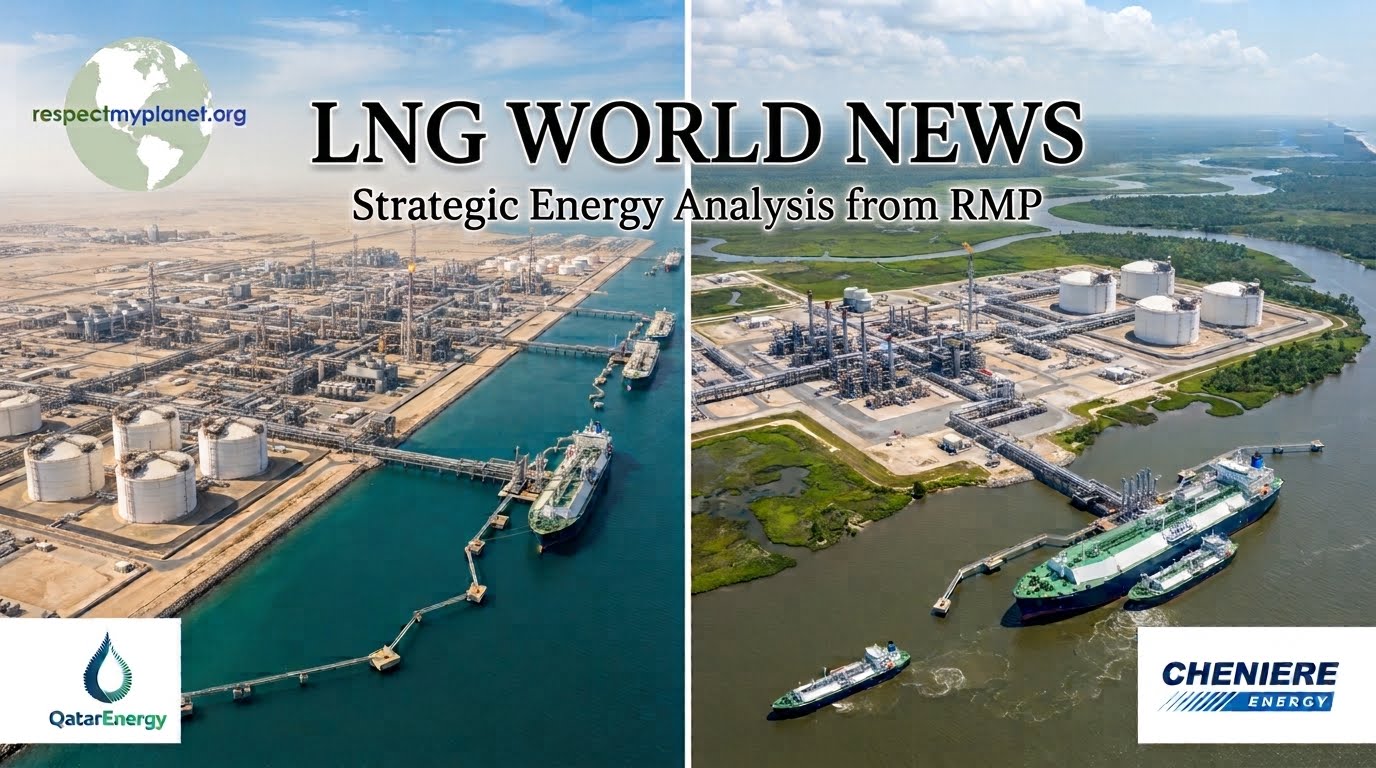
If you have followed the liquefied natural gas market for more than ten minutes, you know that geopolitics and energy flows are joined at the hip. Even by global energy standards, however, the events of the last eighteen months read like a script that any seasoned industry watcher could have seen coming from a mile away. In May 2025, the Qatari royal family handed over a $400 million luxury Boeing 747-8 to the United States government to serve as an interim Air Force One.[1] Less than a year later, a U.S.-led air war with Iran broke out in the Persian Gulf, choking off the Strait of Hormuz and leaving Qatar’s massive export machine battered and sidelined.[2] Now, in the ultimate market irony, state-owned QatarEnergy is signing multi-decade contracts to buy millions of tons of American LNG just to keep its global trading business alive.[3]
When you line up the timeline of diplomatic gifts, military strikes, and multi-billion-dollar gas deals, a clear picture emerges: the conflict in the Middle East has permanently broken Qatar’s historic grip on the global LNG market and handed the keys to U.S. Gulf Coast exporters.
From Undisputed King to Crippled Exporter
To appreciate just how wild this reversal is, you have to look at where Qatar stood before the United States entered the Lower 48 export game in 2016. For years, Qatar was the undisputed heavyweight champion of the LNG world, controlling roughly 30% to 33% of global supply and acting as the price-setter for buyers across Europe and Asia. Even as American export capacity exploded over the last decade—eventually overtaking Qatar as the world’s top supplier in 2023—Qatar still accounted for nearly one-fifth of the global LNG trade heading into 2026.[4]
That dominance hit a brick wall in March 2026. Following the outbreak of war with Iran, missile and drone strikes slammed into QatarEnergy‘s crown jewel at Ras Laffan Industrial City, knocking out two of its 14 liquefaction trains.[5] That single blow wiped out 12.8 million metric tons per year of production, representing roughly 17% of Qatar’s total export capacity, with repairs expected to take three to five years (5). Combine damaged infrastructure with Iranian attacks on commercial shipping in the Strait of Hormuz—the sole maritime exit for all Qatari gas—and Qatar’s export volumes fell off a cliff. Exports halted completely for three months starting in March, and even by the third quarter of 2026, Qatar managed to ship only 4.58 million tons, less than a quarter of its volume from the year before.[6]
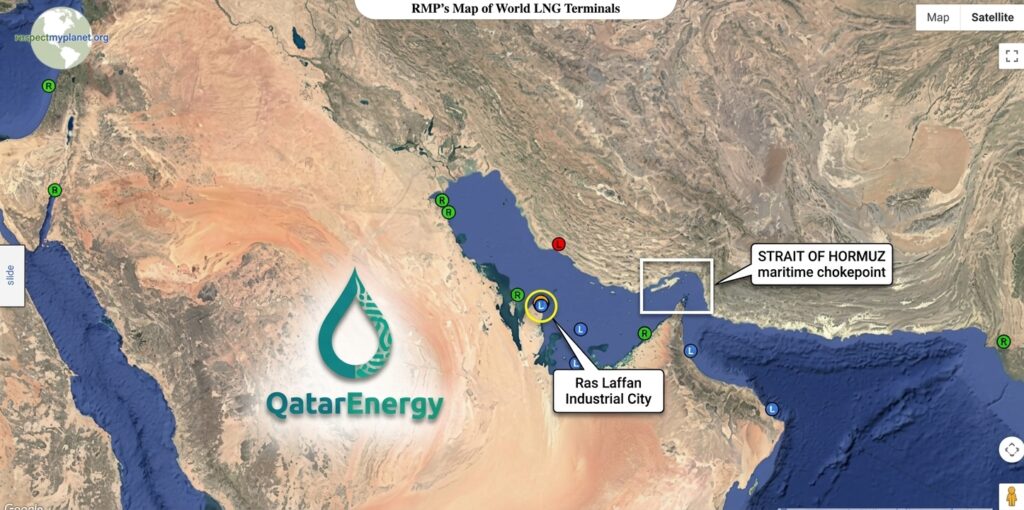
With the Strait of Hormuz restricted and 17% of Ras Laffan offline, QatarEnergy was forced to declare force majeure on global deliveries. You can see Qatar's Ras Laffan LNG terminal on RMP's map of all global LNG terminals by clicking here.The Financial Fallout and Customer Defections
When you cannot get tankers through the Strait of Hormuz, force majeure declarations quickly follow, and customers start looking for the exit. QatarEnergy CEO Saad Sherida Al-Kaabi estimated annual revenue losses of $20 billion from the Ras Laffan strikes alone (7). Between January and June 2026, QatarEnergy’s net profit plunged 69% to $4 billion as revenue dropped 35%, while the International Monetary Fund projected Qatar’s overall economy to shrink by nearly 16% for the year.[7]
Meanwhile, long-term buyers who signed up for Qatari reliability are losing patience. On November 10, 2026, Polish energy giant Orlen officially terminated one of its long-term supply contracts with QatarEnergy—a deal covering 1 million metric tons per year that was supposed to run until 2034—citing months of undelivered cargoes under force majeure.[7] Across Europe, gas storage entered November at just 72% full, the lowest level for that date since records began in 2011, forcing buyers to scramble for alternative supplies.[8] Across the globe, the Middle East conflict has added an estimated $39 billion to the world’s total LNG import bill in 2026, pushing global spending to $256 billion despite lower overall purchase volumes.[9]
If You Can’t Ship It, Buy It From Texas and Louisiana
Facing a damaged export complex, a blocked shipping lane, and angry customers, QatarEnergy made a move that would have been unthinkable a decade ago. In October 2026, Doha went shopping on the U.S. Gulf Coast to lock in dependable supply outside the Persian Gulf.[3]
First, on October 22, QatarEnergy signed 24-year sale and purchase agreements with Cheniere Energy to buy 4 million metric tons per year from the Sabine Pass and Corpus Christi terminals starting in 2031 and running through 2054.[10] Just one week later, on October 29, QatarEnergy inked a 20-year deal with Woodside Energy to purchase another 3 million metric tons per year from the Louisiana LNG project near Lake Charles starting in 2030 (11). Add those 7 million tons of new contracts to QatarEnergy’s existing 70% ownership stake in the Golden Pass LNG terminal in Texas—which began exporting in March 2026—and Wood Mackenzie projects that Qatar will be buying up to 23.7 million metric tons of American LNG annually by 2033.[3] Put simply, the world’s former LNG king is on track to become the single largest buyer of U.S. liquefied natural gas.[3]
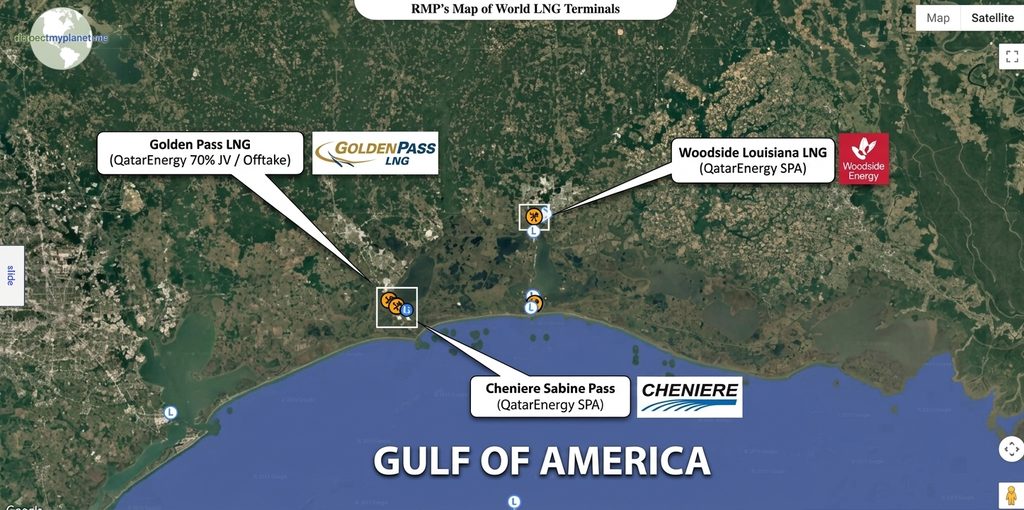
QatarEnergy is projected to secure up to 23.7 million metric tons per year of U.S. LNG by 2033 to safeguard its global trading portfolio. The above image of the Gulf of America is from RMP's Global LNG Map. As you can see from RMP's map markers, Golden LNG is represented with an orange logo as "Under Construction" at the time of this post. Cheniere's Sabine Pass (America's OG from 2016) is represented with the white L on a blue background which means "Online". To the NE is Woodside's Louisiana LNG also represented with an orange logo and "Under Construction. Click here to see these locations on RMP's interactive map.The $400 Million Elephant in the Hangar
Which brings us back to that gleaming Boeing 747-8 sitting on the tarmac at Joint Base Andrews. Back in May 2025, following outreach from Trump administration envoys, Qatar’s ruling House of Thani gifted the luxury widebody jet—valued at roughly $400 million—to the United States government for free.[11] The Pentagon accepted the plane, tapped L3Harris to strip and retrofit it with classified military communications and defenses at an estimated cost of up to $934 million, and unveiled it as the interim “VC-25B Bridge” Air Force One in June 2026, with plans to eventually donate it to Trump’s presidential library foundation.[12]
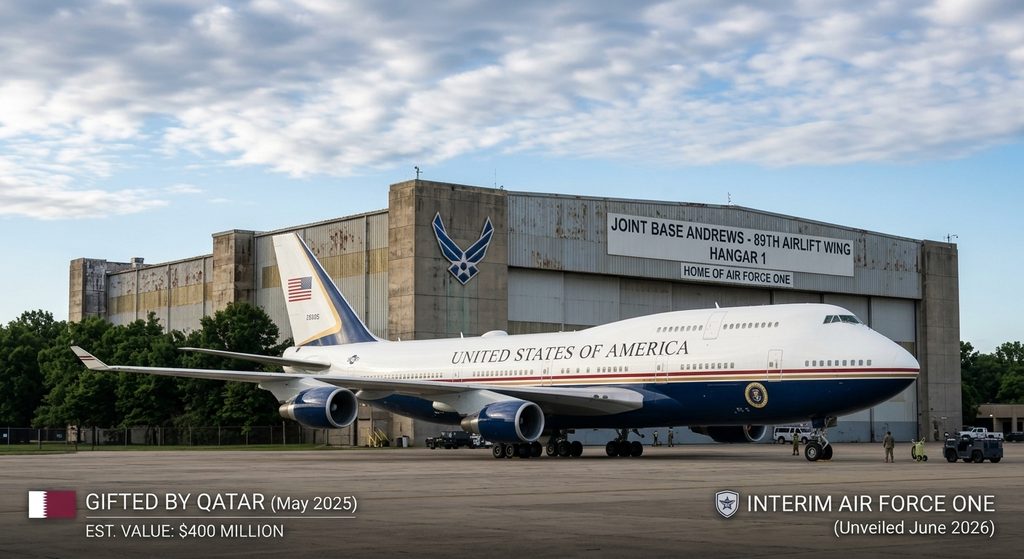
Gifted in May 2025 by Qatar to the U.S. for President Trump, and unveiled as an interim Air Force One in June 2026—right in the middle of a war that kneecapped Qatar's energy sector. President Trump's gift in return: attacking Iran, which launched missiles at Qatar's Ras Laffan LNG complex and choked off the Strait of Hormuz—collapsing Qatari LNG export volumes by 96% over six months and sending long-term contracts up in smoke under force majeure. To add insult to injury, QatarEnergy ended up signing multi-decade deals to buy American LNG to supply its global customers.Now, put on your favorite tinfoil hat for just a second and look at the sequence of events. Think about it. If you wanted to kneecap your biggest competitor in the global gas trade while supercharging the value of U.S. Gulf Coast export terminals, starting a war right next door to the Strait of Hormuz is about as predictable a catalyst as you could draw up on a whiteboard. Action A leads directly to Reaction B: bombs fall in the Gulf, Hormuz closes, Qatari gas gets trapped, global prices spike, European and Asian buyers panic, and suddenly every molecule of LNG coming out of Louisiana and Texas is worth its weight in gold. Even Qatar itself has to line up at the U.S. cash register to buy 23.7 million tons a year just to stay relevant (3).
Of course, I am not saying anyone actually engineered a regional war just to pump up Henry Hub and Cheniere’s order book. That would be crazy talk, right? Let’s call it a happy coincidence for American energy dominance. Still, if I were sitting in a palace in Doha right now—watching my Ras Laffan trains burn, watching my GDP drop 16%, watching Poland tear up my contracts, and writing billion-dollar checks to Texas gas plants while my $400 million jet flies around painted in red, white, and blue—I might be muttering a few choice words under my breath about how that trade worked out.
Whether by grand design or pure geopolitical chaos, one thing is beyond debate: the center of gravity in the global LNG market has permanently shifted to North America, and it is not moving back anytime soon.
Explore the Global Shift Yourself
Want to see every terminal, liquefaction train, and export project shaping this new energy map—including Golden Pass, Sabine Pass, Corpus Christi, and Louisiana LNG? Head over to our main site and explore our interactive Global LNG Infrastructure Map to track capacities, ownership stakes, and project timelines in real time.
Footnotes:
Footnote [1] – “Trump unveils modified Qatari luxury jet meant for Air Force One.” BBC News, June 19, 2026, https://www.bbc.com/news/articles/cn8kz80n157o.
Footnote [2] – “The Iran War is transforming liquefied natural gas deals.” Marketplace, November 11, 2026, https://www.marketplace.org/story/2026/11/11/the-iran-war-is-transforming-liquefied-natural-gas-deals.
Footnote [3] – “Iran effect: Qatar turns to US LNG, set to become world’s biggest buyer.” International Finance, November 6, 2026, https://internationalfinance.com/commodity/iran-effect-qatar-turns-to-us-lng-set-to-become-worlds-biggest-buyer/.
Footnote [4] – “Iran missile attack on Qatar causes ‘extensive damage’ to facility housing huge gas plant.” CNBC, March 18, 2026, https://www.cnbc.com/2026/03/18/iran-war-qatar-ras-laffan-natural-gas-lng.html.
Footnote [5] – “QatarEnergy declares force majeure after Iran strikes on Ras Laffan facility.” Fox Business, March 19, 2026, https://www.foxbusiness.com/economy/iranian-strikes-cut-17-qatar-lng-output-threatening-global-supply.
Footnote [6] – “Qatar turns to US LNG to cushion Iran war losses.” Iran International, November 2, 2026, https://www.iranintl.com/en/202611029934.
Footnote [7] – “Poland terminates Qatar gas deal after months of disruption.” Arabian Gulf Business Insight (AGBI), November 11, 2026, https://www.agbi.com/oil-and-gas/2026/11/poland-terminates-qatar-gas-deal-after-months-of-disruption/.
Footnote [8] – “Flagship Energy’s Mike Stafford Energy Markets Update – 11th November.” Energy Live News, November 11, 2026, https://www.energylivenews.com/2026/11/11/flagship-energys-mike-stafford-energy-markets-update-11th-november/.
Footnote [9] – “The Iran War Just Added $39 Billion to the World’s LNG Bill.” OilPrice.com, October 26, 2026, https://oilprice.com/Energy/Natural-Gas/The-Iran-War-Just-Added-39-Billion-to-the-Worlds-LNG-Bill.html.
Footnote [10] – “Cheniere Signs Long-Term Sale and Purchase Agreements to Supply QatarEnergy with LNG through 2054.” Cheniere Energy, Inc., October 22, 2026, https://lngir.cheniere.com/news-events/press-releases/detail/348/cheniere-signs-long-term-sale-and-purchase-agreements-to.
Footnote [11] – “Woodside Signs 20-Year LNG Supply Agreement With QatarEnergy.” Yahoo Finance / Business Wire, October 29, 2026, https://finance.yahoo.com/energy/articles/woodside-signs-20-lng-supply-091200101.html.
Footnote [12] – “Former Qatari aircraft on track for summer Air Force One delivery.” Defense News, May 4, 2026, https://www.defensenews.com/air-warfare/2026/05/04/former-qatari-aircraft-on-track-for-summer-air-force-one-delivery/.
Leave a Reply