
A significant environmental incident occurred in Michigan this past week when the Edenville Dam failed on May 19, 2020. The resulting impacts from Midland to Saginaw Bay and Lake Huron are substantial and will likely be felt for many years. Downstream communities face extensive property damage, and the long-term cleanup of contaminated sediments—affecting drinking water sources and fisheries—will place added strain on Michigan’s environmental remediation resources.
The failure of the Edenville Dam and the loss of Wixom Lake raise serious questions about whether different lake-level management decisions could have reduced the risk. Maintaining safety margins appears not to have been prioritized, and the consequences are now clear.
In the days ahead, there will be political debate, extensive media coverage, and technical investigations into the causes and contributing factors behind the dam’s failure. As part of this effort, RMP will review two reports today that provide useful insight into conditions and decisions leading up to the collapse.
1) The Four Lakes Lake Level Study prepared by Spicer Group & with support from Clark Hill at the behest of the Four Lakes Task Force (FLTF), the Gladwin County Board of Commissioners & the Midland County Board of Commissioners. The lake level study was published in April 2019. It was the support case used to get Judge Stephen Carras’ signature for ‘legal’ lake levels which in essence were ‘vanity’ lake levels despite concerns of potential dam failure.
2) The Four Lakes Task Force 2019 Annual Report and Operating Plan published April 16, 2020. It is very interesting that the comprehensive annual report for the Four Lakes Task Force was published just a few weeks before the dam would have catastrophic failure. The annual report gives a comprehensive view into many legal & financial considerations of fixing the dam just before Edenville’s dam failure became a national spectacle; the financial report is a snapshot of the situation just before disaster struck.
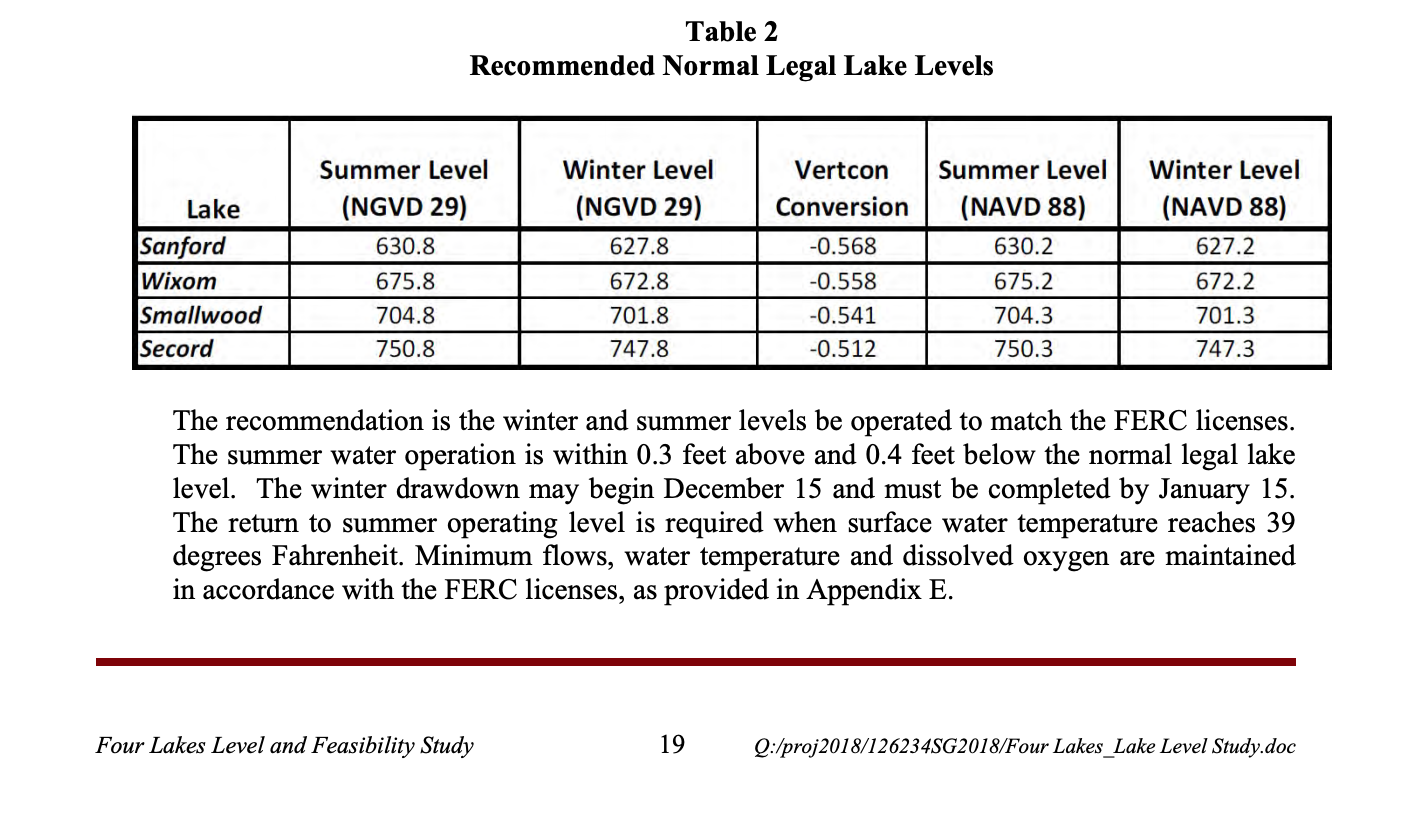
In the coming weeks, the term “legal level” will appear frequently in discussions of the Edenville Dam failure. This refers to the lake levels established by Judge Stephen Carras when he issued a Lake Level Order under Part 307 of the Natural Resources and Environmental Protection Act, 1994 PA 451, as amended (MCL 324.30701 et seq). That order set the normal, or legal, lake levels for Wixom, Sanford, Smallwood, and Secord Lakes (the “Four Lakes”).
The Four Lakes Special Assessment District (SAD) acknowledged the Four Lakes Task Force (FLTF) as the county-delegated authority responsible for acquiring, repairing, and operating the four dams on behalf of Midland and Gladwin counties. The established lake levels were documented in the Four Lakes Lake Level Study prepared by the Spicer Group and commissioned by the FLTF.
Michigan Attorney General Dana Nessel has publicly referenced these court-ordered lake levels, noting that the State did not set the water level for Wixom Lake, but that it was established by a court order. She has also stated that the purpose of litigation involving EGLE and the DNR is not to increase lake levels, but to seek damages related to the prior lowering of the lake in 2018 and 2019, which resulted in environmental impacts, including mussel mortality.
The argument that Boyce should not have lowered lake levels due to potential harm to mussels is difficult to reconcile with the evidence presented in the two key documents referenced in this article. When those documents are read together, a different and arguably more plausible sequence of events emerges: lake levels appear to have been maintained primarily to preserve recreation and aesthetics, rather than to protect aquatic species.
This raises important questions. Why would the State pursue financial penalties against a company that lacked sufficient resources to bring the dam into compliance with safety requirements? Framed this way, the mussel-related justification warrants closer scrutiny. A central focus of this post is to examine what drove the establishment of the court-ordered “legal level” and whether safety considerations were adequately weighted in that decision-making process.
The safety of Michigan residents and freshwater resources appears to have been treated as an underlying assumption—that existing operations could continue safely—based largely on the Four Lakes Lake Level Study commissioned by the FLTF. However, the study’s emphasis suggests that lake levels were set to support recreation and shoreline interests more than immediate dam safety concerns.
Safety does not appear to have been a short-term priority in the Four Lakes Lake Level Study, but rather a long-term objective targeted for completion by 2024. For years, it was well known that the Edenville Dam was in disrepair and failed to meet Michigan dam safety standards under Part 315 of NREPA (MCL 324.31501 et seq). While a long-term plan existed to achieve compliance, the dominant near-term objective of the Lake Level Study was to maintain higher lake levels. This priority is stated on the first page of the study’s introduction and summary, which notes:
“The flowage rights for remaining lakes, for the most part, are currently held by Boyce Hydro… The Counties of Midland and Gladwin have petitioned the Circuit Court to establish legal lake levels to protect the interests of the property owners who directly benefit from the existence of these lakes as well as the interests of the Counties.”
The study further states that the FLTF was “pursuing preemptive action to avert the draining of the lakes.”
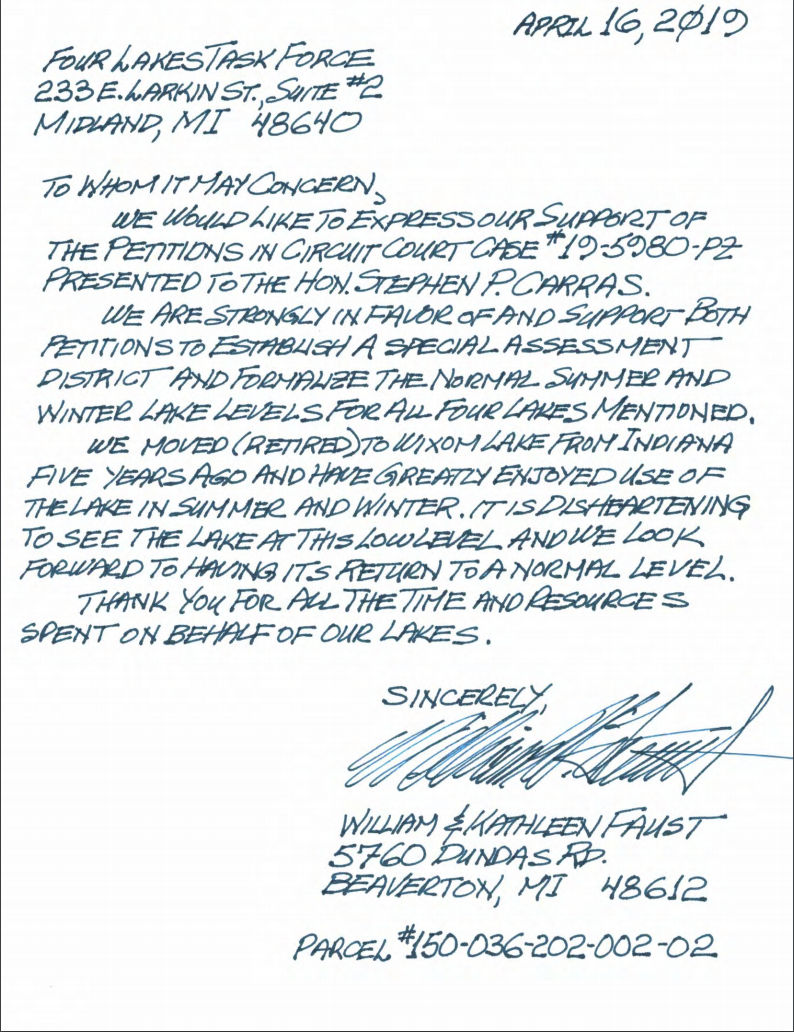
Property owners with lakefront investments on these man-made lakes commissioned a study to establish legal lake levels in order to protect the interests of those who directly benefit from shoreline property. That purpose is stated plainly in the introduction of the report itself. Notably, within the 332-page comprehensive study used to support the establishment of legal lake levels, the term “mussel” does not appear.
Given that omission, the assertion that the State of Michigan’s lawsuit against Boyce Hydro was primarily about protecting mussels deserves careful reexamination. The rationale appears difficult to substantiate based on the record cited in support of the legal lake levels. Instead, the lawsuit raises broader questions about enforcement priorities and the practical consequences of pursuing significant financial penalties against a dam operator already struggling to fund necessary safety upgrades.
If a company lacks the resources to complete dam repairs before a multi-million-dollar lawsuit, its ability to do so afterward is unlikely to improve. This invites a reasonable question: why pursue an adversarial legal approach against the same entity tasked with working alongside MDEQ/EGLE to operate and ultimately rehabilitate the dam? Regardless of past disputes, ensuring public safety and protecting Michigan’s water resources would appear to require cooperation as much as enforcement.
How, then, did the situation reach a point where the Attorney General filed suit against the dam operator for not maintaining “legal levels” that were established through a Spicer Group study commissioned by the FLTF and later formalized through a court order signed by Judge Stephen Carras? That question remains central to understanding the decisions and motivations that led to this outcome.
What prompted the FLTF to form?
The Four Lakes Task Force (FLTF) was set in motion in September 2018 after the Federal Energy Regulatory Commission (FERC) revoked Edenville Dam’s power generation license for non-compliance. Shortly thereafter, the dam owner lowered Wixom Lake by roughly eight feet. At the time, there were no known objections or violations cited by MDEQ or MDNR, but the drawdown angered lakefront property owners and became the catalyst for the formation of the FLTF.
The FLTF’s motivation is clearly documented in its own materials. Lakefront property owners—along with those holding dedicated easement access—were frustrated that Boyce Hydro controlled lake levels without their input and had lowered the lake substantially. This moment triggered a legal process that ultimately resulted in higher court-ordered lake levels. Critically, that process made it illegal to lower lake levels even for safety reasons, despite the fact that the Edenville Dam had been known to be in serious disrepair for years and should not have had its levels raised until repairs were completed.
The FLTF was acting to protect property investments, not to cause an environmental catastrophe. That motivation is understandable. However, safety concerns appear to have been overshadowed by a desire to maintain lake levels for recreation and aesthetics. With 6,555 lakefront parcels and nearly 2,000 additional parcels with easement access, the pressure to keep lakes full was substantial. While legal documents frame the effort as establishing “historical” lake levels, there is reasonable evidence that preserving property value and appearance was a primary driver.
When FERC relinquished oversight, regulatory authority transferred to MDEQ (now EGLE). This makes it essential to examine how EGLE evaluated safe lake levels and emergency drawdown authority. If the dam was known to be deficient and repairs were estimated at roughly $20 million, it is reasonable to ask why lake levels were not set more conservatively—especially given that May is historically the rainiest month in Midland County. Threats of major litigation may also have discouraged precautionary lake-level reductions, even when safety concerns were present.
It is important to distinguish between agency staff and leadership. The engineers, scientists, and technical staff within MDEQ/EGLE are dedicated professionals working to protect Michigan’s environment, often with limited resources. Concerns here are directed at leadership decisions and enforcement priorities, particularly the choice to pursue costly litigation while dam safety funding and engineering capacity remain inadequate.
This tragedy demands serious scrutiny of how lake levels were set, how safety was weighed against competing interests, and whether common-sense precautions were sidelined. Readers are encouraged to review the two documents referenced in the introduction and draw their own conclusions. RMP is not aligned with any political organization; its focus is, and has always been, Michigan’s water. In the end, the water—and the communities that depend on it—are the true victims.
This post was updated on February 6, 2026 to improve clarity and readability.

Leave a Reply