
Each month respectmyplanet (RMP) recaps the past 30 days of oil & gas activity in the Michigan Basin. We cover new applications & permits to drill oil, gas, disposal, and storage wells and anything else hydrocarbon related. We recap oil & gas activity that happens in Michigan and publish this Michigan Oil & Gas Monthly (MOGM) magazine right here at the end of each month. You can follow us on Twitter by clicking here, or like us on facebook by clicking here and you won’t miss a publication. Our publications are free and always will be. Have a tip for us about a leaking tank or a spill near your house? Or, are you curious about something oil & gas related you see that you want us to dig into? Let us know by leaving a comment at the bottom of this article.
Michigan oil & gas has awoken from its 2016 slumber with August being a very
busy month. While we are still technically off to the slowest year in Michigan oil & gas history, things certainly picked up speed in August. The MDEQ’s Office of Oil Gas & Minerals received more applications for oil & gas wells in August than in the previous seven months combined. We are still likely on pace to have the slowest year ever in Michigan history, breaking last year’s record, but this month was a busy one nonetheless.
Early in the month Interstate Explorations out of Houston, TX filed an application for the Root 1-15 well to use high volume hydraulic fracturing (HVHF) in Roxand Twp in Eaton County targeting the Prarie Du Chien formation. That got me to thinking about HVHF again and I thought it would be a good idea to check in on Michigan’s HVHF wells producing from the Collingwood formation as we haven’t checked in on those wells in about a year. We will drop in on the Collingwood wells later in this MOGM and look back on Michigan’s HVHF history.
Also in August, Savoy Energy filed applications targeting of the Trenton-Black River formation in Lenawee & Monroe counties, which is something new. Most oil wells targeting the Trenton group of rocks in Michigan is along the Albion-Scipio trend, which is a remarkable series of synclinal oil & gas traps of Middle Ordovician age. Michigan’s Trenton group of rocks along the Albion-Scipio trend have produced 70x more oil than all other Middle Ordovician age rocks in Michigan combined. So, we will keep an eye on Savoy Energy’s Trenton-Black River exploration in Lenawee County & Monroe County to see what they find.

To keep things going with the flurry of activity in August, Core Energy has applied for a horizontal injection well in their Chester EOR unit in Otsego County. RMP is watching Core Energy activity closely as they have been working with the US Department of Energy on Carbon Dioxide sequestration technology, which is a topic that RMP advocates for and supports. RMP will be mapping out all of Michigan’s CO2 injection wells and its supporting infrastructure to understand our Michigan #CCS scenario better. CO2 sequestration (often called #CCS which stands for Carbon Capture & Sequestration) is a big topic across the country and around the world. RMP is Michigan’s fuel cell authority and we recently wrote about Molten Carbonate Fuel Cells and their role in #CCS in our Fuel Cells 101 – Learning the Basics post.
Fuel Cell Energy out of Danbury, CT recently direct issued $40 million worth of common stock to ExxonMobil who plans to implement $FCEL’s Molten Carbonate Fuel Cells around the world to capture Carbon Dioxide whence it can be stored underground just like what Core Energy is doing right here in Michigan. RMP will be watching & reporting on how Core Energy’s, ExxonMobil’s, and Fuel Cell Energy’s activities all fit together for Michigan and the rest of the world. ExxonMobil will soon be announcing the location of their upcoming pilot plant using $FCEL’s molten carbonate fuel cells and you’ll hear about it first on RMP’s Twitter & facebook; RMP is Michigan’s fuel cell authority.
A Look Back at Michigan’s HVHF Collingwood Wells Using LVWWs
RMP has been following HVHF since it started in Michigan in 2008. Friends of the Au Gres & Rifle River, along with RMP, wrote a white paper on HVHF in Michigan originally published in September 2012, which you can read about by clicking here. Our paper was again updated in November of 2014 to account for some additional activity that occurred subsequent to the original publication date, but we had already gathered, parsed, and analyzed enough information in 2013 to determine that there would likely never be another LVWW for hydraulic fracturing in Michigan after the Westerman 1-29 HD1 well. When Halliburton rolled off the Westerman 1-29 HD1 pad in June of 2013, all the circus-like activity of HVHF using LVWWs was over in Michigan. Period. And, it’s never going to be coming back unless someone is looking for a loss leader for a tax write-off.

Many people treat the University of Michigan’s Graham Sustainability Institute’s Integrated Assessment (IA) of high-volume hydraulic fracturing (HVHF) as an authoritative study on the subject in Michigan. RMP and its volunteer research team do not share that view. Based on years of fieldwork, data collection, and analysis, we believe the IA is fundamentally flawed in key areas, particularly in its treatment of Michigan’s geology and production outcomes.
RMP’s guiding research principle has always been that geology matters—“it’s all about the rock.” However, the Graham Institute’s executive summary (September 2015) suggests a disconnect from this fundamental reality. By that time, the empirical record in Michigan already showed that HVHF had failed to produce economically viable results.
Michigan’s first HVHF well was drilled by Beacon in Sanilac County in 2008. It failed. Since then, no HVHF well in Michigan has been commercially successful. Hundreds of millions of dollars were spent by multiple operators—including Devon, Chesapeake, EnCana, Blackstone-backed Rosetta and GeoSouthern, and Marathon—testing Michigan’s formations using HVHF. All attempts failed to meet economic expectations. These wells primarily targeted liquids, not dry natural gas, and were drilled when commodity prices were near historic highs.

By 2013, it was already clear that HVHF activity in Michigan had ceased due to poor results, despite continued booms in states such as Pennsylvania, Ohio, Texas, North Dakota, and Wyoming. Yet the Graham Institute’s executive summary, published in 2015, did not reflect this reality.
RMP volunteers documented every HVHF well site in Michigan in real time, photographing each stage from staking through reclamation and building a public, free-access timeline of the activity. This raises a fundamental question: what data sources informed the Graham Institute’s conclusions, and why did they diverge so sharply from observable outcomes?
One example of this disconnect concerns water usage in Antrim wells. RMP analyzed 992 well completion reports using custom-built software and found average water use to be 6,805 gallons per well (including nitrogen foam completions) and 11,457 gallons (excluding them). However, the Graham Institute relied on an unsupported Michigan Department of Environmental Quality (MDEQ) figure of 50,000 gallons per well, even after RMP shared its dataset and methodology.

The IA team also declined opportunities to observe an actual HVHF completion in Michigan, including the Garfield 1-25 HD1 well. Instead, they visited an Antrim well, which differs substantially in scale and technique. RMP has often compared this distinction to the difference between a mouse and a blue whale—both mammals, but fundamentally different in size and behavior.
RMP has long maintained that Michigan’s Collingwood Shale could never be economically viable. EnCana invested over $230 million in its Collingwood program, yet cumulative revenue through mid-2016 was only about $32.6 million, with the State of Michigan receiving approximately $6.5 million. While Marathon has managed to improve production from these wells, likely through operational adjustments, the formation remains uneconomic.
The largest-producing Collingwood well, State Excelsior 3-25 HD1, has surpassed $10 million in total revenue, yet this does not change the broader conclusion: the play has failed financially.
This history explains why RMP has consistently predicted—since 2013—that Michigan will not see another Collingwood HVHF attempt or large-volume water well completion. The data support that conclusion.
The Graham Institute’s IA, by contrast, was published after the industry had already walked away. In that sense, it arrived too late and missed the core geological and economic realities that defined HVHF in Michigan.

August 2016 – List of New Oil & Gas Well Applications
Michigan received 19 applications in August more than doubling the total number of applications received for all previous 7 months of the year. This brings the total number of applications for 2016 up to 30. While we are still on pace to break 2015’s record for slowest year ever, August was still a busy month.

August 2016 – List of Permits Issued for Oil & Gas Wells
In August 2016, Michigan issued three new permits. Since there are only 19 permits so far this year, all permits for 2016 are shown below. The bottom three permits on the list were issued in August.

August 2016 – Oil & Gas Wells Published as Plugged
Only six wells were reported plugged in August bringing the total wells reported plugged for 2016 up to 83.

The August 2016 Apps to Plugs Ratio KPI:
The apps to plugs ratio is self explanatory. By looking at the number of applications to wells plugged KPI we can see wells coming vs wells going. This KPI along with the previous one supports our original 2014 & 2015 outlook post with more numbers and data.
2016 Apps to Plugs Ratio KPI:
30 Applications : 83 Wells Plugged
The August 2016 Permits to Plugs Ratio KPI:
The permits to plugs ratio is nearly the same as the apps:plugs ratio but with permits instead of applications.
2016 Permits to Plugs Ratio KPI:
19 Permits Issued : 83 Wells Plugged
August 2016 – Petroleum As % Of U.S. Trade Deficit KPI:
RMP is tracking this stat since President Obama signed a bill in December of 2015 that lifted an export ban on crude oil that had been in place since 1970. RMP will be monitoring the effect of that federal legislation by monitoring an important economic statistic published by the United States Census Bureau. The data and graph (shown below) come from this website: https://www.census.gov/foreign-trade/statistics/graphs/PetroleumImports.html
This stacked-area line graph shows how much of the monthly US trade deficit can be attributed to the deficit in petroleum products. The vertical axis shows percent of the U.S. Goods and Services Trade Deficit. The horizontal axis shows a monthly time series from January 2006 to present. The bottom area of the graph shows what percent of the deficit comes from petroleum goods. The top area shows the percent of the deficit coming from non-petroleum goods and services. RMP made a prediction the day the bill was signed that this graph would trend toward zero which is a good thing for the US economy.
Recently, however ,we see two consecutive month’s of upticks causing oil companies continued pain caused mostly by Saudi Arabian actions.

Closing Remarks – August 2016
Finally in the August 2016 MOGM we touch back on the main reason why RMP publishes this monthly magazine: to advocate for the responsible migration away from crude oil as an energy source because it causes contamination to our groundwater. It’s important for RMP to demonstrate we understand oil & gas so we don’t get bullied as know-nothings by a very tough and well-funded industry. But, it’s also important for RMP to consistently demonstrate how oil is contaminating our groundwater and is bad news for our economy and national security in the long run.
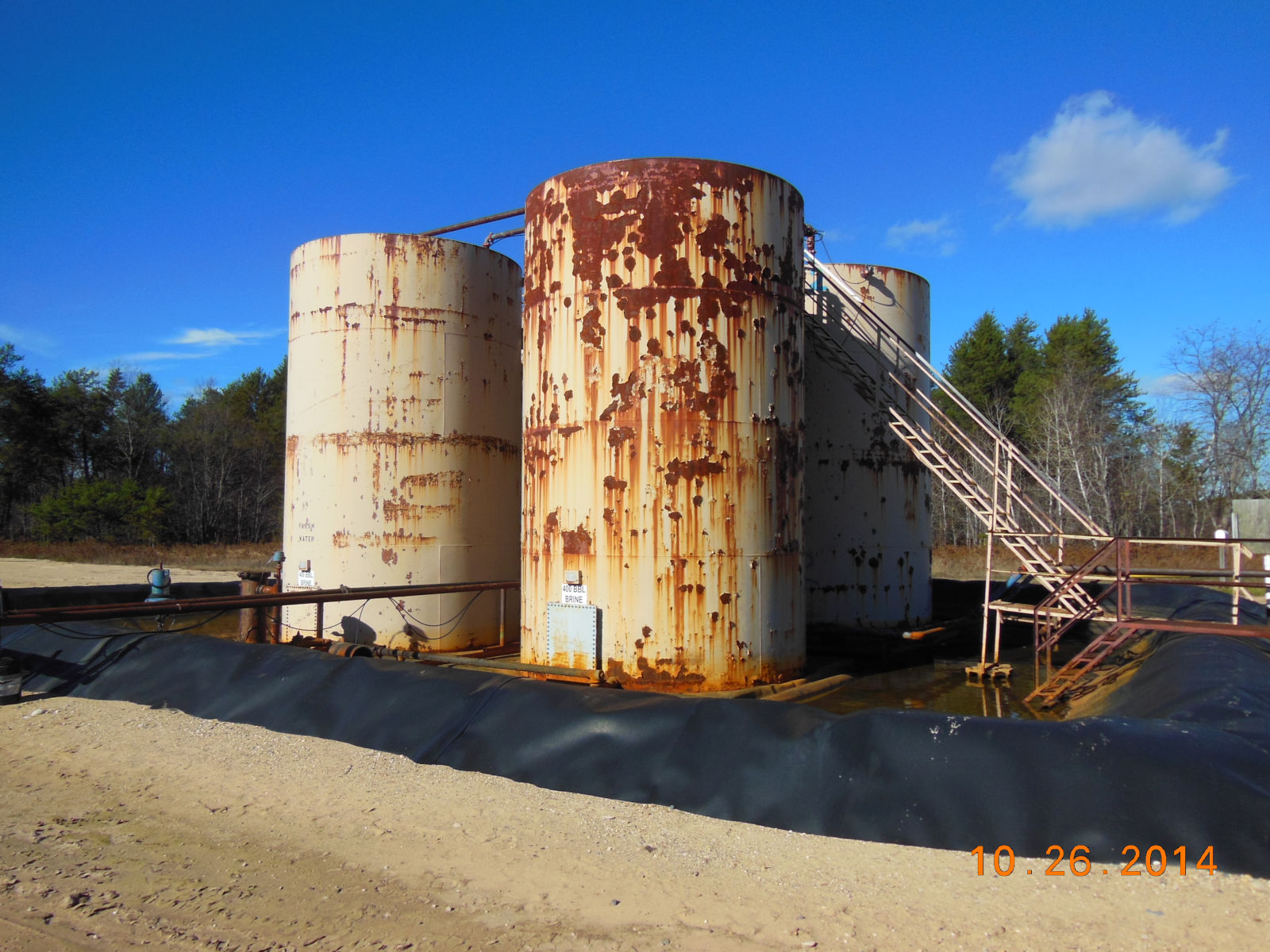
We again find this month another example in a long list of examples whereby hydrocarbon storage tanks have contaminated Michigan’s freshwater resources. A Muskegon Development tank battery in Roscommon County was discovered to have polluted Michigan ground water and was reported by Muskegon Development on July 5, 2016. RMP has demonstrated in numerous posts that hydrocarbon storage tanks above and below ground are the biggest threat and burden to Michigan’s environment & economy posed by hydrocarbons.

We as Americans have used oil to our benefit for a long time and the quality of life improvements we have gained as a society from using hydrocarbons like crude oil for energy are undeniable. But, we now have the technology in hydrogen fuel cells to migrate away from crude oil as an energy source and create new jobs for our oil field workers as well as dramatically cut our military costs while improving our national security. We should, and we must responsibly migrate away from oil to improve our economy, environment, energy security, and national security for the benefit of future generations. This whole website and every post written here is a repository for information that supports this simple point. RMP takes this stance not to attack the oil industry or threaten its workers as we recognize our own dependence on oil; but rather, we call out these common sense points to take a sober look at what is best for America’s future generations. RMP understands that the migration away from oil will take decades and must be done in a responsible way to protect workers in the oil industry and the economy at large.
If you’re interested in reading about this latest spill discovery that was reported by Muskegon Development you can request a copy of the Site Status Report prepared by Pescador LLC out of Traverse City, MI for the tank battery spill in Roscommon County. I would upload the document for you to DL from this site but it is too large (60MB) for RMP to attach on our tiny server space which is rented on a shoe-string budget. You can read about the tank battery that required the removal of over 2,354 tons of contaminated Michigan soil. You can read about the ground water monitoring well that was installed that showed readings of ethlybezene & total xylenes above GSI criteria and also 1,2,3 TMB and 1,2,4 TMB levels above both RDW & GSI criteria. You can wonder to yourself: why wasn’t this found sooner? You can wonder to yourself: how could over 4,700,000 pounds of Michigan soil get contaminated with hydrocarbons before it was discovered again by happenstance rather than protocol? How many years did this leak go on undetected? It’s inexcusable neglect and unacceptable. And still, does the MDEQ publish a monthly listing of EQP-7233 forms for Michigan taxpayers to read? No.
Why doesn’t the MDEQ publish a listing of every EQP-7233 filed each month which is easily compiled information to host on their website? RMP has to sleuth for it and FOIA for it. It’s a terrible practice that keeps Michigan taxpayers in the dark about the underbelly of using crude oil for energy. One of RMP’s long time volunteer contributors who watches over the Au Sable watershed has to send multiple boilerplate FOIAs every single month on the 15th of the month individually by county just to find out if a spill has occurred in past 30 days. Let’s fix this. Let’s demand that the MDEQ publish a listing of every EQP-7233 form on their website every single month. It is so easy to do and would shed light on all the contamination caused to our freshwater by oil & gas. These actions could hasten the adoption of hydrogen fuel cells and create excellent high-paying jobs for Michiganders and true energy independence.

There are literally thousands of liquid hydrocarbon tanks leaking in Michigan contaminating our groundwater. The biggest problem in Michigan and every other state in America is actually refined hydrocarbon product storage tanks (i.e. gas stations & distribution stations) In fact, the count of the Michigan LUST list as of the date of this publishing is 9,543 tanks under active remediation at 2,809 unique locations. In fact, Michigan has an entire section of law dedicated to acceptance of the fact that there are so many thousands of these contamination sores across Michigan that we (along with every other state in America) have become complacent in accepting dealing with these messes as a standard routine. Gasoline & diesel fuels are a shitty and obsolete way to power our cars & trucks. But, RMP is here to tell you there is a better way. RMP thinks outside the box and has a solution to phase out this problem along with the phase out of crude oil pipelines. This is why RMP has self-declared itself as Michigan’s fuel cell authority non-profit 501(c)3 environmental group. By switching to fuel cell electric vehicles like the Toyota Mirai, we can responsibly migrate away from gasoline and diesel as a fuel source; and more importantly as a contamination source to our freshwater.
Michigan spends on average over $30 million dollars a year on remediation of these tanks that contaminate our water. There is in fact an entire cottage industry of high paid mucky mucks that profit from this contamination and dozens of Michigan forms administered with our tax dollars that can be responsibly faded to antiquity if we no longer used refined petroleum products to power our cars and trucks.
On Dec. 30, 2014 Michigan Governor Rick Snyder signed Senate Bill 791, creating Public Act 416 of 2014. This amends Part 215 of the Natural Resources and Environmental Protection Act (NREPA), PA 451 of 1994, and authorizes the creation of the Underground Storage Tank (UST) Cleanup Fund (The Fund). The Fund will be used going forward to reimburse owners of tanks for cleanup costs. RMP will be writing much more about The Fund in future posts. We can make an eye opening calculation of the money spent to clean up hydrocarbon spills in Michigan related to underground storage tanks in the past as follows : with 10,430 unique locations on the closed LUST list and the estimated cost of each clean up site of roughly $250,000 per location we have everything needed to do some simple math. The number of locations closed multiplied by the average cost per site equates to $2,607,500,000 to clean up messes using gas & diesel for our cars & trucks. That’s not a misprint, that’s $2.6 billion dollars for cleaning up our polluted water because of refined oil products. Think of what we could do with that money if it didn’t have to be wasted on cleaning up such messes.
RMP has no money to further our mission advancing sustainable energy solutions that create good paying jobs, but we know exactly what to do with money if we could get some. RMP knows what to do to affect legislative action that can put us on the path toward ending this senseless contamination of our freshwater resources for future generations (my kids – your kids – and their kids). Think about it. If you’ve got $600k to spare, go ahead and click on that donate button in the upper right hand corner of your screen; it’s a tax deductible donation because we are a 501(c)3 with a license to solicit from Michigan’s Attorney General. Thanks for reading. See you next month.


Leave a Reply